
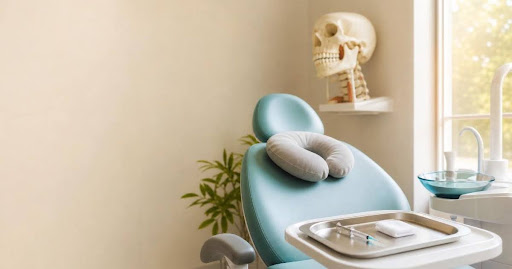
You wake up with a sore jaw. By mid-afternoon your temples ache, and your dentist keeps pointing at the wear on your back teeth. Many people live with this for years, because the cause is a muscle that works overtime while they sleep or concentrate. Masseter Botox, often called jaw Botox, relaxes that chewing muscle so it clenches with less force. Dr. Casey Price offers therapeutic Botox at Price & Baker Family Dentistry in Clanton, Alabama, for patients who haven't found relief from jaw tension and grinding with other treatments. This post walks through how the treatment works, who tends to be a good candidate, what an appointment looks like and what the research shows so far.
What Is Masseter Botox?
The masseter is a thick muscle on each side of your face that runs from the cheekbone down to the lower jaw. Place a finger just in front of your earlobe, below the cheekbone, and bite down. The bulge you feel is the masseter tightening. It is one of your main chewing muscles, and it does most of the work when you clench.
Botox is a purified form of botulinum toxin. When a provider injects a small amount into a muscle, it blocks the nerve signal that tells that muscle to contract. With less signal getting through, the muscle relaxes and cannot squeeze as hard. The effect is temporary and gradually wears off as the nerve signal returns, which is why treatment is repeated over time.
Providers inject the masseter for two different reasons. The cosmetic use shrinks an enlarged muscle to soften a square lower face, and people often call that jaw slimming. The therapeutic use treats clenching, grinding and jaw tension. This post is about the therapeutic side, which is the jaw treatment Price & Baker offers. Jaw Botox for these concerns is planned around how hard your muscle works and how your teeth are wearing, so the goal is comfort and protection for your bite.
How Botox for Teeth Grinding and Jaw Clenching Works
Bruxism is the word for grinding and clenching, and it comes in two forms. Sleep bruxism happens while you rest. Awake bruxism happens during the day, often while you drive, work at a screen or feel stressed. Estimates of how common sleep bruxism is in adults run from 8% to 31% depending on how it is measured, and one review put awake bruxism at 23% worldwide.
Many people do not know they grind until a partner hears it or a dentist spots flat, worn molars. Morning jaw soreness and a dull ache at the temples are other clues that the muscle has been busy overnight.
Grinding wears teeth down, cracks fillings, breaks crowns and shortens the life of dental work you already paid for. Every night of clenching removes a little more enamel, and worn teeth become sensitive teeth. Enamel that is gone does not come back. When a tooth is already damaged, Dr. Price can rebuild it with crowns and bridges right here in Clanton, and managing the muscle is the step that protects that work afterward.
A night guard shields your teeth from the force of grinding. Relaxing the muscle reduces the force itself. For many patients the two work best together, and Dr. Price can tell you whether your wear pattern is severe enough to justify treatment.
People who ask about Botox for teeth grinding often want to know if the research backs it. A systematic review of nine randomized trials found fewer grinding events and lower pain scores in some of the studies, along with less jaw stiffness. The authors describe the findings as preliminary, so the results are encouraging, but more research is needed.
Botox for TMJ: What It Can and Cannot Do
TMJ refers to the temporomandibular joint, the hinge that connects your lower jaw to your skull. TMD is the name for a group of problems in and around that hinge. According to the National Institute of Dental and Craniofacial Research, TMD covers more than 30 conditions in three broad groups: jaw joint disorders, disorders of the chewing muscles, and headaches linked to TMD. It affects about 5% of U.S. adults, and it is at least twice as common in women as in men.
Botox acts on the muscle side of that list. A person whose pain comes from an overworked masseter may feel a difference, and a person whose pain comes from the joint itself has a different problem that needs a different answer.
Botulinum toxin is FDA-approved for some conditions, such as migraines, and it is not approved for TMD. Using it for TMD or bruxism is called off-label. Studies of it for TMD have had mixed results, and it remains unclear whether it relieves symptoms. The same source says experts recommend starting with conservative treatments and avoiding anything that permanently changes the joints, teeth or bite.
That is the reason Dr. Price examines your jaw, your bite and the wear pattern on your teeth before recommending anything. Jaw pain has several possible sources, and Botox is the right answer for some patients while others are better served by a different path. When your symptoms sound like something other than a dental muscle issue, she refers you to your physician.
Signs You May Be a Good Candidate
Patients usually start asking about masseter Botox after dealing with the same symptoms for a while. A sore or tight jaw first thing in the morning is the most common. Others notice discomfort that builds after a long day of clenching, or a headache or temple tension that rises and falls with how much they clench. When the jaw muscles stay contracted for hours, the tension travels into the temples, the sides of the head and down into the neck and shoulders.
The teeth often tell the story too. Visible grinding wear, fillings that crack, crowns that break and dental work that never seems to last all point toward a muscle that is pressing harder than your teeth can handle.
Price & Baker describes the people this treatment is right for in three groups: patients with chronic jaw tightness, soreness or clenching-related discomfort who have not found relief from other approaches; patients whose teeth show grinding wear, who break dental work regularly or who have been told they clench in their sleep; and patients with recurring temple or head tension that tracks alongside clenching or grinding.
Botox isn't for everyone. Product safety information and clinical sources list pregnancy or breastfeeding, neuromuscular disorders, an infection at the injection site and an allergy to botulinum toxin among the reasons to skip it. At your first visit, we'll review your health history and talk through whether Botox is right for you.
What Happens at a Masseter Botox Appointment
The visit starts with a conversation. Dr. Price reviews your medical history, then examines your jaw, your bite and your teeth. She talks through the results that are realistic for you and gives you the cost before anything is scheduled.
If you move forward, she injects the thickest part of the masseter on each side of your face. Most patients describe a brief pinch. The needle is very fine and each injection takes seconds. Dr. Price adjusts the amount based on how strong your jaw muscles are, so there is no single dose that fits every patient.
Most Botox appointments are quick, and most patients go straight back to their day. Aftercare for Botox commonly includes avoiding rubbing or pressing on the treated area and skipping strenuous exercise for about 24 hours, so the product stays where it was placed.
Results typically show up within three to seven days. Many patients report less jaw soreness, less tightness and easier opening within a couple of weeks. The effect lasts about three to four months, which varies by person and by how strong the muscle is. Patients treating heavy clenching sometimes find that results last longer over time as the muscle gradually does less work.
Side Effects and Safety
Most side effects of masseter injections are mild and short-lived. Tenderness and small bruises at the injection sites are the most common. You may notice your jaw tires more quickly when chewing tough foods such as steak or jerky while the muscle is relaxed. In a review of 2,036 masseter injection sessions, a temporary decrease in chewing force was reported in 30% of sessions and bruising in 2.5%.
Less common effects relate to where the product goes. If it spreads toward the muscles that lift the corner of the mouth, a smile can look uneven, and that was reported in 0.15% of sessions in the same review. Untreated muscle nearby can occasionally bulge as other fibers take over the work, which showed up in 0.49% of sessions.
Careful placement is what keeps these effects rare. The authors of that review recommend injecting inside a safe zone within the muscle, at three to four points that sit at least a centimeter from any border. Staying inside the masseter and away from the smile muscles protects your expression, and that is where Dr. Price's training in the anatomy of the jaw matters most.
When treatment is done well, you can talk, laugh and show expression normally. The face still moves, with less tension in the jaw. The product's labeling also carries a boxed warning about distant spread of toxin effect, which is one more reason to have a trained provider who reviews your health history first.
Why See a Dentist for Jaw Botox
Botox works by relaxing a specific muscle, so results depend on knowing exactly which muscle, exactly where and exactly how much. Dentists spend their education on the anatomy of the head, face and jaw. Dr. Price maps the muscles that control your bite every day, and she brings more than 20 years of dental experience to that work.
A dentist who already sees your bite and your wear pattern can look at how your jaw muscles and teeth work together. Grinding, bite, worn teeth and jaw tension are connected, and a night guard and Botox can be planned together. Price & Baker offers therapeutic Botox for jaw tension and clenching as well as cosmetic treatment, and Dr. Price is specially trained to offer both.
Dentists in Alabama must meet specific training and safety requirements before offering this treatment. The Board of Dental Examiners allows dentists to give botulinum toxin for therapeutic purposes, including TMJ disorder and orofacial pain, within a dental or medical facility. Before treatment the dentist must establish a dentist-patient relationship, take a medical and dental history and perform a clinical exam. The dentist must personally perform the injection, and must have completed board-approved training that covers head and neck anatomy, patient selection, management of complications and live hands-on practice.
Price & Baker is one of the few dental practices in the Clanton area offering Botox, so a fifteen-minute appointment does not require a drive to Birmingham. You see the same building, the same team and the same chair you already know.
Cost depends on how many units you need, and Dr. Price gives you an exact figure before anything is scheduled. Insurance coverage for therapeutic use varies by plan and is often limited, and the team helps you understand what your own plan says. If your jaw has been telling you something for a while, you can Schedule a Botox Appointment and get a straight answer about whether this treatment fits you.
